Where does the water we drink come from? A Hidrofiltros guide on water safe for consumption!
It's common to look at the water that comes out of our faucets and think everything is fine with it. After all, it's treated, right? Well, it should be that simple, but it isn't — find out more in this post.
Can we drink the water that comes out of our tap?
It's common to look at the water that comes out of our faucets and think everything is fine with it. After all, it's treated, right?
Well, it should be that simple, but it isn't.
In this post, we'll explain why. Stay with us!
Where does the water we drink come from?
A question as basic as it is fundamental for us to understand the scope of this issue.
If you have basic sanitation at home, that water comes from treatment plants, right? Partly. Before reaching your home, water from treatment plants is drawn from rivers, springs, and reservoirs, which in turn are formed by rainwater and receive sewage (treated or not) from our homes and industries.
This is where the problem begins
That fragrant soap and shampoo we use in the shower leaves chemical residues that are carried away by water. The same goes for the dish soap we use at the sink, the laundry detergent, the disinfectant that keeps the house clean — it all goes down the drain and into the sewage system, right?
In industries, the process is similar, but Conama (the National Environment Council), together with municipal and state agencies, regulates that before discharging water, a pre-treatment must be carried out to remove the chemical residues used and generated in the production process, in order to minimize environmental impact.
Even so, the water that leaves there is not yet safe to drink.
All these chemical compounds, combined with the pesticides used in food production, flow through two paths: sewage treatment plants or rivers and water sources. In the first case, the water is treated before being returned to its original source, removing the most polluting residues. In the second, sewage is discharged directly into the river. Once in the environment, the water undergoes a natural purification process before being collected and taken to a treatment plant, where it goes through a cleaning process to remove residues harmful to our health.
It turns out that 15 inorganic chemicals(heavy metals), of 15 organic chemicals(solvents), seven chemicals derived from household disinfection, and 27 types of pesticides present in the water are controlled by the Ministry of Health's ordinance the WHO (World Health Organization) recommends a much larger number for monitoring.
These discarded materials are harmful to health and have given rise to what is being called emerging pollutants/contaminants.
It is common, for example, to hear about situations like that of residents in the Tiradentes neighborhood in São Paulo, who reported feeling ill after consuming tap water. Among the reported complications were diarrhea, nausea, and headaches, caused by the presence of bacteria in the water.
This makes us wonder: are the minimum standards in place truly adequate for our health?
Groundwater contamination: are mineral waters also at risk?
Some studies also point to the incidence of groundwater contamination, such as the presence of Nitrite in an urban sub-basin in Fortaleza. This occurs through soil contamination which in turn carries these
This scenario also raises a concern that is beginning to be evaluated by various institutions. In France, for example, the NGO 60 Million Consumers and the Danielle Mitterrand-France Libertés Foundation commissioned a study to evaluate the quality of bottled water, and traces of pesticides and medications were found, such as tamoxifen, a hormone used in breast cancer treatment (JORNAL DO MEIO AMBIENTE, 2014).
In 2002, a study published in the Revista de Saúde Pública reported the presence of total coliforms in bottled water, concluding that 94.5% of mineral waters sold in the Marília region are suitable for consumption.
These are preliminary data and still very low rates, but they also keep us alert to the quality of the water we are consuming, don't they?
A social problem. Is there anything that can be done?
What we have presented here is a summary of a highly complex issue that has persisted for years in Brazil and around the world, involving political and social attitudes: the contamination and degradation of the environment, which is reflected in the contamination of our water.
But what can be done right now to help reduce this impact?
The same old advice: Conscious Consumption and Responsible Production
An age-old tip, but a very sound one, since our economic foundation revolves around consumption. Therefore, paying attention to what we are consuming and who provides solutions to our problems is an act of responsibility toward the environment.
Yes, we know that choosing companies that care about sustainability in their production process is not always affordable. But if you can pay a little more, why not?
Moreover, there are other ways to consume consciously by adopting a few habits:
- Planning: do you really need to buy that item right now, or can it wait a little?
- Evaluating: does the item you're thinking of purchasing have a major environmental impact? Is there a similar alternative that delivers more for less?
- Reusing: don't buy again what you can repair.
- Reducing: reflect on your real needs and try to live with less.
Reuse Water
Another way to help in this process of recovering and sustaining our resources is by treating water at your home, building, or business so it can be reused for washing outdoor areas, toilet flushing, and more.
Important: for reuse water to become safe for consumption, it must be sent back to a treatment plant, ok?
For both of these solutions, there are companies specialized in water treatment that can offer a complete solution tailored to each situation's needs.
Choosing companies that offer products with a longer lifespan
It may seem like we're tooting our own horn, but here at Hidrofiltros we research extensively to offer products with a longer lifespan — so you produce less waste. The Refil Facile C3, for example, has a lifespan of 10,000L (1 year), while most products offer a lifespan of 6 months.
The refill compatible with Consul purifiers, such as the HF-CSL, also follows this approach, offering 3,500L — 3x more than the competition offers for the same model.
For drinking water free of pollutants:
Taking care of our common home is something we do every day through the products we offer to the market. We are always committed to ensuring your family's health. That's why we bring you certified products so you can drink the best water.
Check out our product line:
For a water treatment system:
Filters, membranes, tanks, and valves make up a water treatment system for reuse or disposal, designed by specialized companies.
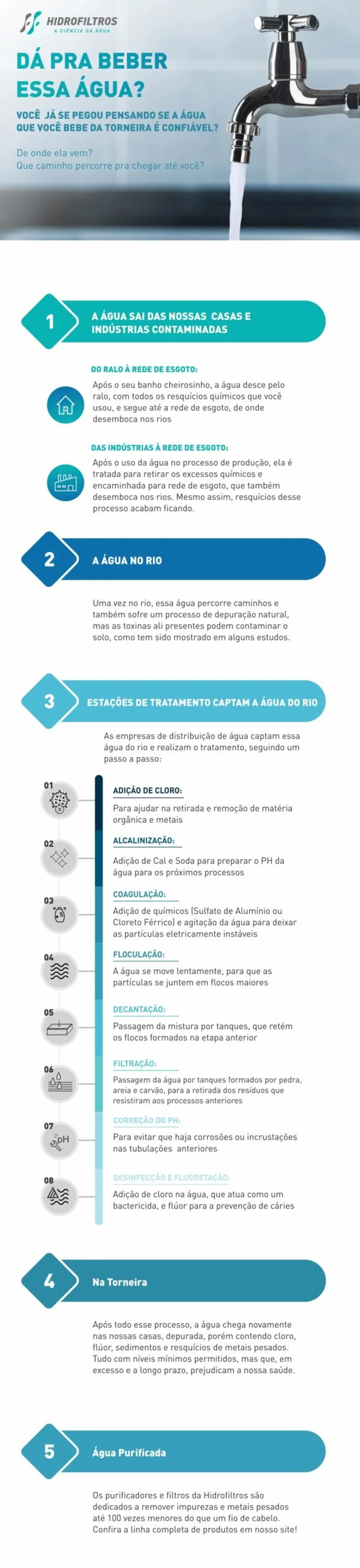
Infographic
Click on the image to download the infographic.
Research Sources:
https://www.jornaldomeioambientesp.org/conteudo.php?opcao=not&id=882
https://super.abril.com.br/mundo-estranho/para-onde-vai-o-coco-depois-da-descarga/
https://www.desentupirja.com.br/para-onde-vai-o-esgoto-da-sua-casa/
https://novaescola.org.br/plano-de-aula/5076/o-caminho-da-agua-ate-a-nossa-casa#_=_
https://www.youtube.com/watch?v=qkZqKizLoBs
https://www.youtube.com/watch?v=zNA7pLbTLSg
https://timfazciencia.com.br/para-saber-mais/o-caminho-da-agua-da-represa-as-torneiras/
https://www.eldogomes.com.br/torneiras-com-filtro-confira-seus-beneficios/
Scielo: Mineral Water Contamination
http://www.cprm.gov.br/publique/media/informacao_publica/rel_anual_2019.pdf
http://www.cprm.gov.br/publique/Acesso-a-Informacao/Acesso-a-Informacao-1873.html#relatorios_dados
The science of water,
straight to your inbox.
Technical guides, maintenance and product news — once a month, no spam.
More articles for you
 Notícias
 HIDROFILTROS EXPANDED ITS PRODUCT CAPACITY WITH CUTTING-EDGE INVESTMENTS
New injection and extrusion machines expanded output, and a distribution centre in Espírito Santo brings delivery closer to Brazil's Southeast, North and Northeast.
 Consumidor Residencial
 HIGH LEVELS OF PESTICIDES IN DRINKING WATER!
A survey by Brazil's Sisagua found pesticides in water meant for human consumption. What that means for health, and how filtration reduces the risk.
 Consumidor Residencial
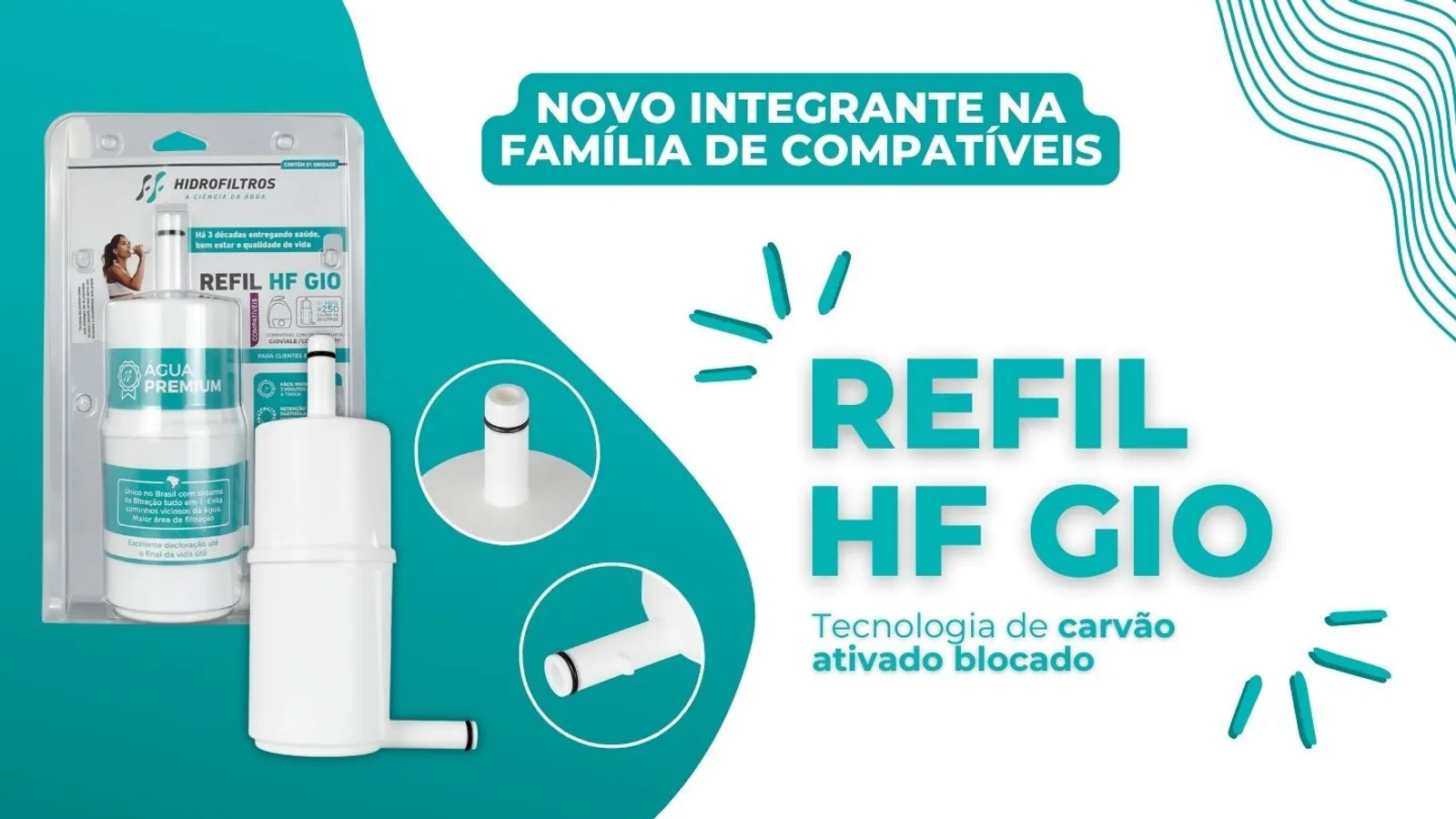
 NEW LAUNCH: HF GIO FILTER CARTRIDGE
The HF GIO refill joins the compatibles line with block carbon, which prevents channelling of the water and cuts the plastic used to build the element.